
18. Sophia Conway ~ the color of heartbreak

“Perhaps some day I'll crawl back home, beaten, defeated. But not as long as I can make stories out of my heartbreak, beauty out of sorrow.”
—Sylvia Plath
Sophia Conway truly writes with heart and soul. Her poems are visceral and memorialize the author’s own moments of relationships, motherhood, grief, and injustices. In this small exhibit of Conway’s innovative haibun and revolutionary haiku and senryu, there is a concise balance of poems that are witness-based protest and those that resemble diary entries, but no matter the tone, she consistently delivers powerful and necessary sustenance. Socially and environmentally conscious, Conway embraces writing about difficult topics like capitalism, domestic violence, and climate change. While the phrasing in Conway’s work is sometimes experimental-leaning, her poems are always well-rooted in traditional haikai technique. She frequently chooses concrete imagery over narration and uses descriptions that deeply engage the senses. It is this attention to detail that breathes her poems to life and creates a vivid, shared experience for her audience. Conway writes for the common folk; for the new mother, for victims of bullying, for third wheels, for those who have lost love, and for those who rally for peace. Poems like Conway’s invite each reader to experience prolonged empathy and compassion, for she makes stories out of her heartbreak and beauty out of her sorrow.
Rowan Beckett Minor, confluence associate editor
poems
star-shaped crackers
my son's mouth full of
crumbling constellations
red shoes line the school fence -
the color of heartbreak
calls for peace
a quiet courtyard miles
from the reality
tangerine
another rolling sphere
out of orbit
third wheeling
the bookmark between
love poems
baby blanket
the flow of grief
seamless
couple’s therapy
studying the Richter scale
skeleton hands
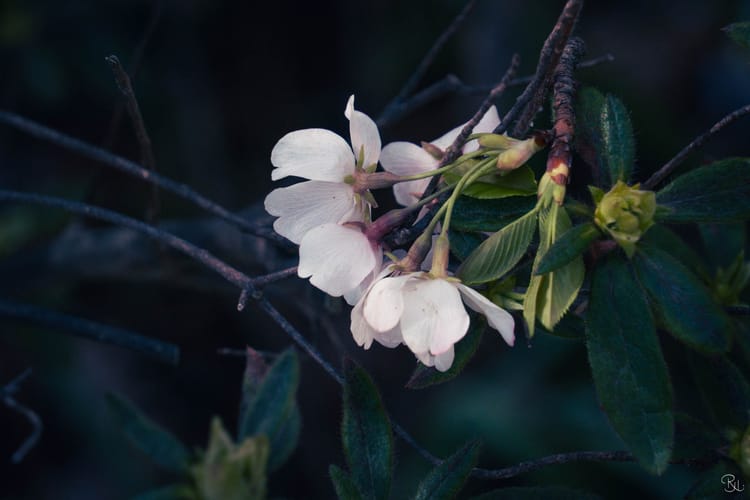
blossom branches strangle
the weeping sky
sunday service
a ripple of memory
casts me adrift
nosey neighbors
the gossip weaves a damning
tapestry
date night
cobwebs unravel in the corners
of my smile
no encore
watching his last smile
fade
he loves me
x-rays reveal what's broken
he loves me not
6 feet taller
than he’ll ever be
graveyard pebbles
drifting
the seasons ask me
where I’m going
deep water
forgetting what our laughter
sounds like
talk of climate change
realizing my world ended
long ago
termite hill
thousands of miles of
tax-free construction
Hunger
I will not steal other people's lunches.
I will not steal other people's lunches.
I will not steal other people's lunches.
I will not steal other people's lunches.
I will not steal other people's lunches.
like little Gretel
her childhood scattered
with crumbs
BLUE YELLOW
The students swarm together like a disturbed hive; clutching flags and raging for peace in the university courtyard. This old city drowned in hurt and hopeful cries. The cobblestones below have felt the march of iron boots before.
single raindrops
one long night until the
pond overflows
Proof
Dole Vita Bar & Restaurant
21-05-2024 | 21:25
Lasagne 1 17.50
Wine-R 1 8.99
Pro. Pizza 1 16.25
Mojito 5 9.50
TOTAL: 90.24
he says sorry
she drowns her sorrows
in clouded rum
Blithe Spirit
Cafe Haiku
Crumbs & Constellations: A Haiku Story Mini Chapbook
Residential School Victims Memorial
Tan-Ku for Ukraine: A World Haiku and Tanka Anthology
essay
an act of rebellion
My belief is that writing haiku is both an act of therapy and rebellion. It’s not hard to see how it can be therapeutic, but its rebelliousness is what piques my interest the most.
In a society often referred to as ‘the rat race’ where busyness and endless striving are idolized, stepping out of that endless march to pause, reflect, and observe the natural world around us in order to write a haiku can feel like a small but rebellious act. Society doesn't need haiku, but it does need the kind of people who write haiku. . . people who will remind it to take a moment to observe and reflect, marvel at nature’s beauty, elevate the small moments, and capture the complexities of life in three seemingly simple lines. This is one of many things that haiku poetry has to offer the world.
commentaries from Fellows
Deborah Karl-Brandt, Vidya Premkumar, & Margaret Walker
Deborah Karl-Brandt
Many people struggle in today's society as competition continues. The biggest house and the fanciest car seem to be the goals most people strive for. But is it really worth trying?
Sophia Convey's haiku remind us that we are human beings.
third wheeling
the bookmark between
love poems
We long for affection, we suffer loss, we grieve, we love, we are abused, we heal.
baby blanket
the flow of grief
seamless
he loves me
x-rays reveal what's broken
he loves me not
If you read her poems closely, you will discover many different types of relationships. This senryu teaches you about the ups and downs of human existence and about the feelings that make us human. As a mother, a woman of faith, and an immigrant, she lets us see the world through her eyes.
drifting
the seasons ask me
where I'm going
I think one of the most important things poetry helps us achieve is to gain new perspectives, new insights, and new knowledge. I am deeply grateful that I am allowed to receive such intimate thoughts, that someone else shares their deepest feelings with me, so that we can connect and truly understand each other.
For Sophia Conway, writing poetry is a form of therapy, but also, and above all, an act of rebellion. Her poems help us to realign our life path and lead a simpler, slower, and more authentic life. And that may change our whole lives for the better.
Vidya Premkumar
Sophia Conway’s work glows with quiet conviction and emotional clarity. Her poems transform the act of attention into a form of grace, inviting the reader to pause within moments of both wonder and grief. Through haiku such as:
red shoes line the school fence -
the color of heartbreak
talk of climate change
realizing my world ended
long ago
deep water
forgetting what our laughter
sounds like
Conway distills vast subjects of collective trauma, personal loss, and environmental anxiety into precise, luminous images that linger long after reading. Her writing resists despair by finding meaning in tenderness, stillness, and continuity.
In her essay, Conway beautifully describes haiku as both “therapy and rebellion,” a duality that underpins her craft. Each poem carries the courage to slow down in a restless world and to observe what others overlook. Her language is unadorned yet musical, her imagery immediate yet layered. The sequence from Crumbs & Constellations exemplifies her ability to unite domestic life, motherhood, and mortality into a single emotional current, creating poems that feel deeply lived and profoundly humane.
One way to enhance her already resonant work might be experimentation with sequencing, allowing individual poems to speak to one another in subtle narrative or emotional arcs. Such continuity could expand her exploration of time, memory, and renewal, adding a momentum to the stillness she renders so beautifully.
Sophia Conway’s voice is luminous and grounded, compassionate and brave. Her poetry restores the reader’s capacity to feel and to look again at the ordinary world with reverence. It is a gift of attention that feels both intimate and restorative.
Margaret Walker
The reader does not have to know anything about Sophia Conway to be immediately aware that she is telling her story. Written in first person, each of what she calls “three seemingly simple lines” tell the reader with stark clarity that her poetry is “an act of therapy."
6 feet taller
than he’’ll ever be
graveyard pebbles
With a handful of carefully chosen words, Conway makes no attempt to hide her pain. Yet, the reader is not just left with a sense of sorrow without pity but instead with admiration for the courage and skill it takes to write so openly:
couple’s therapy
studying the Richter scale
Sophia tells us she “enjoys writing haiku in inventive ways." She meets this goal again with simplicity when in her haibun “Proof” she uses a restaurant receipt in place of the prose. With one item:
Mojito 5 9.50
the reader is prepared for the haiku that follows:
he says sorry
she drowns her sorrows
in clouded rum
Thank you for reading! We invite you to continue the conversation by hitting the "comment" button below. Feel free to share your favorite poem of Sophia's or your reactions to her work. Sophia and the editors look forward to reading and responding to your comments.
If you liked the issue, we also welcome you to share this with others in your community. Stay tuned for the next issue later in March, which will feature work by Anthony Q. Rabang.



Member discussion