
23. collaborations ~ the space between

Community is at the heart of confluence, and here in our second year I'm delighted to look back on a year of connection and creativity that spans the globe. We featured eight Fellows in individual issues, welcomed seven Councilors in mentoring and supportive roles, and collaborated with past Fellows and Editors on a community renku as well as written works.
This issue presents a selection of those written works. All told, in various pairings and small groups, our community created 45 collaborative pieces. Each participant was then invited to select a piece to be published in this issue, and to write a brief commentary about that piece.
Here, we see confluence. More than a collection of poets and words, here is the space between, brimming with creation, connection, and reflection.
Matt Snyder, confluence associate editor
40 days and 40 nights
by Nicky Gutierrez and Yvette Nicole Kolodji
with commentary from Ryland Shengzhi Li
waking up
my stomach grumbles
over last night’s fast
seasalt in the air
my ashes still
the fireplace
holding what’s
left of my sins
on my forehead
anointing oil
still glistening
after the rain
This split sequence offers a triptych of suffering, repentance, and grace, held together by the ashes of Lent. The grumbling stomach over a chosen fast—the discontent that shadows even our best intentions. The fireplace—a vessel that holds our pain, and what remains after. The anointing oil—the healing grace that is not washed away by circumstance. All this over the span of 40 days and 40 nights, the duration of the Lenten season. All this in each of the 40 days, and in each day of our lives. Hurt and wholeness are inseparable.
Anthesis
by Sam Renda and Allyson Whipple
with commentary from Nicky Gutierrez
March lilies
what can’t be changed . . .
I choose an extreme
Lenten fast
blooming a month too soon
the parts
that are still just a girl
cold moon
my fresh grey streak
hothouse orchids
another set of curves
comes with age
The first two lines ground the poem where nature is transitioning to Spring, another stage of life, echoed in the later line "cold moon." The lilies cannot be stopped from blooming; while the narrator is trying to take some ownership of the situation, their "Lenten fast" cannot change things. Indeed, “Fast” has a double meaning as it connects the early blooms to the transition of a girl maturing. The “cold moon” evokes the narrator's sadness and perhaps they are even thinking of their own age as suggested by “grey streak” and the final lines of the poem. And above it all we have the title connecting the blooming flowers to the aging people, bringing forth both melancholy and beauty.
At the Mountain Rest
by Rowan Beckett Minor (image) and Margaret Walker (senryu)
with commentary from Lorraine A Padden
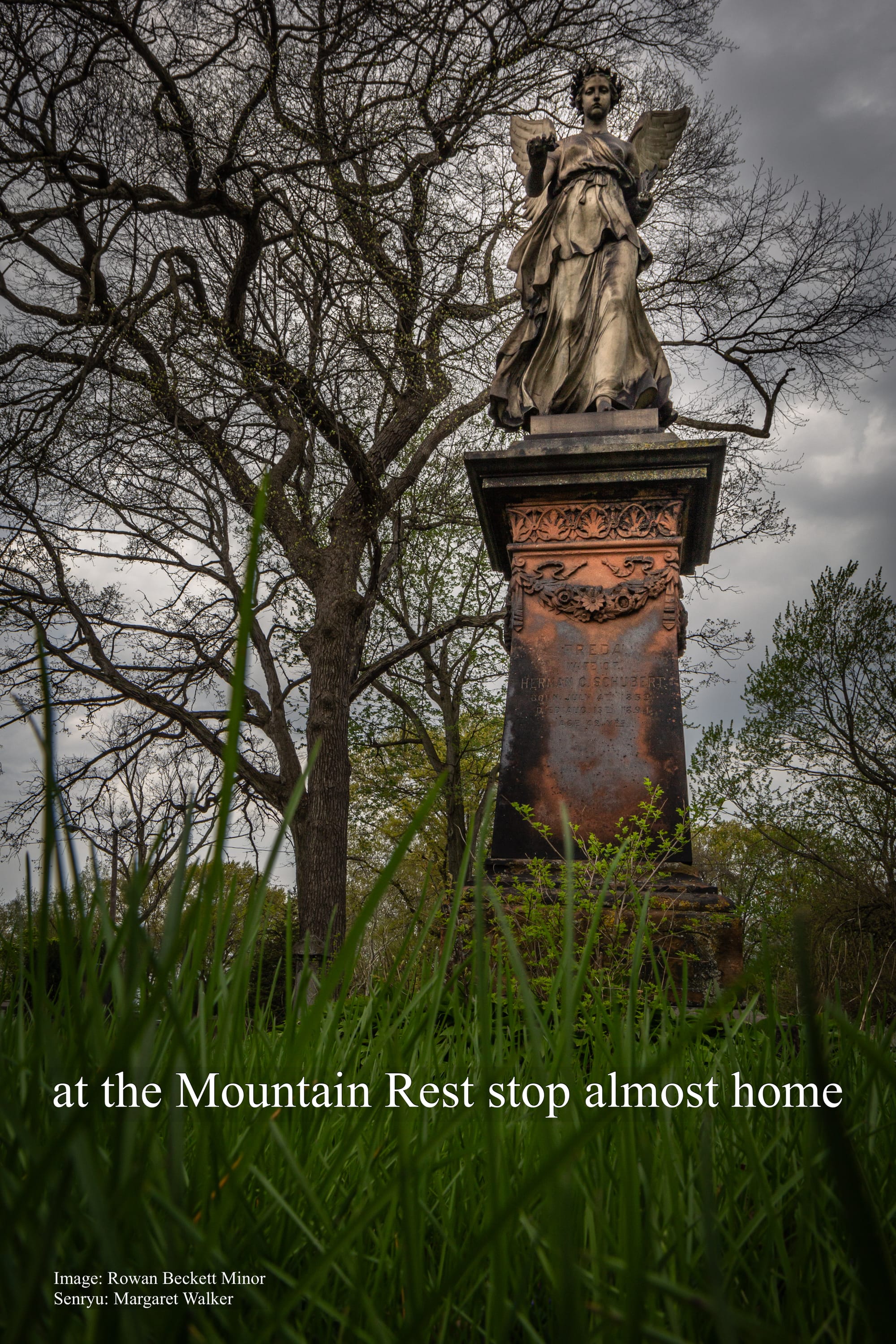
This shahai skillfully combines opposing energies with great poignancy. Against a tangled backdrop of overlapping branches and portentous clouds, the perspective of the photographer (and we as viewers) is just above ground level. This framing choice situates us in the image, accentuating our potential movement through the piece. We peer through overgrown grass to find an enormous stone angel topping a massive grave marker. The statue gazes down at us, pausing in mid-stride, bearing an expression of judgment, or perhaps welcome.
Taking in the single-line senryu, we’re also invited to contemplate the subtle gestures of meaning that further deepen our reception of the piece. Capitalized Mountain Rest may be the name of this disordered place. Rest stop is also a temporary pause for refreshment on a journey. The final two words, almost home, are profoundly moving in their implication of human stillness - our place just under that foreground grass – that’s juxtaposed against teeming multitudes of branches and blades reaching for sky.
Barbules
by Lorraine A Padden (LP), David Green (DG), and Billie Dee (BD)
with commentary from Sam Renda
prickly pear
a cactus wren’s
poco staccato (LP)
the zig-zag necks
of a pelican squad (DG)
palo verde beetle
weight
of a hummingbird (BD)
purple silence
deepens the nest (LP)
un-tuckpointing
the neighbor’s wall
house sparrow (DG)
roadrunner tracks
quilting a skin of mud (BD)
A wonderful piece that revels in the rich tapestry of life. I love that there are words and creatures to look up for the unfamiliar, and with each one comes a tiny discovery that reinforces the whole. The continual reference points back to the title are also exceedingly well done: the colour points in a cactus wren’s plumage. The spiked edges of a palo verde beetle. Tuckpointing, zig-zags and roadrunner tracks.
The overall impression is of sheer delight in the complexity of nature in all its shapes and forms, with the poets firmly backgrounded and simply enjoying the spectacle.
Cosmic Boundary
by Pravat Kumar Padhy (braided haiku) and Colleen M Farrelly (prose)
with commentary from Billie Dee
I unbox his stuff, safely sealed for nine moves now and just as heavy as the last move. I unpack slowly. Methodically. His napkin notes hide on the corner bookshelf closest to the window overlooking a banyan tree. His paper cranes tucked beside my nightstand. Our rings…
chasing in darkness chasing for light
the vastness with no edge
all the dots in the sky
how big is big enough as small we see
chasing in darkness
the vastness with no edge
how big is big enough
chasing for light
all the dots in the sky
as small we see
I pause, staring at the Quadrantids streaking the night sky, and wonder if he would have liked this patio view.
Note from the authors: Braided Haiku is a new poetic form framed out as two stand-alone three-line haiku: one italicized and the other in plain text out of a 4-line micropoem that consists of two monoku: one at the top and one at the bottom and a two-liner in between. Braided Haiku-Prose is a hybrid form combining prose with braided Haiku. For more information, see Pravat's essay in Frogpond 47:2.
Cosmic Boundary carries a quiet emotional weight that stayed with me. I especially admired the opening prose, with its slow, methodical unpacking of a loved one’s belongings after so many moves, and the final return to the Quadrantids, which gives the piece a fitting sense of scale. The braided-haiku section feels genuinely ambitious, and I can see how its repetitions and recombinations are meant to echo the circling mind of grief. For me, the piece is strongest when it trusts its concrete details most fully, since those moments have the deepest resonance.
Deckled Edges
by Allyson Whipple and Sam Renda
with commentary from Deborah Karl-Brandt
deep winter
postcard scraps
the street cleaner
pauses mid-sweep
the wish to see any birds
used bookstore
I read love notes written
on title pages
other than starlings
still unopened…
a mourning dove’s song
finds the wind
This is not a poem to be skimmed over casually. It deals with relationships that have been irrevocably broken. We encounter deep affection—and the longing and loss it brought with it—through a few scattered objects, broken or strewn about. The desire for a turn toward a better future is still there, yet this hopeful wish has been shattered. This work reveals a universal truth: people inevitably change, and feelings evolve over the years. Ultimately, then, we have no choice but to accept this. A truly powerful work of art.
dry wine
by Sam Renda (SR), Anthony Q. Rabang (AR), and Allyson Whipple (AW)
with commentary from Cynthia Bale
dry wine
her real opinion
tip of the tongue (SR)
maggots proliferate
in silent corners (AR)
summer rain...
i settle back into
restlessness (SR)
abandoned frisbee
covered by tall grass (AW)
"dry wine" opens with a character suppressing her thoughts to remain socially palatable. The damage such self-censorship can do is illustrated by a sharp shift into the visceral disgust we associate with maggots, which is then soothed, but only somewhat, by a summer rain that still leaves the speaker restless. Finally, that energy dissipates into the image of a forgotten frisbee, once a centre of flight and action, now vanished beneath grass that has slowly grown to cover it. The poem offers keen insight into the lost potential when things go unsaid.
Redshift
by Pravat Kumar Padhy (PKP), Colleen M. Farrelly (CMF),
and Vidya Premkumar (VP)
with commentary from Rowan Beckett Minor
spacetime …
interacting with the ancestors
in quantum dialect (PKP)
my grief orbiting
Sagittarius A (CMF)
wormholes—
which childhood memories
pull through (VP)
in cosmic playground
dark matters hold us together (PKP)
event horizon
my mind orbits
his death (CMF)
baryon acoustic ripples—
the patterns we settle into (VP)
This short speculative renku effortlessly intertwines the authors’ personal history with scientific concepts, making this both an analytical and emotional piece. Tapping into themes like death and childhood memories, each author uses natural and technological philosophies to link the verses together, while shifting into different forms of loss. The audience is taken on a journey of heartache and bereavement, and is left with only the patterns of how deep grief affects us. Although some terms like “wormhole” are more common, it is appreciated that lesser known theories are referenced, which forces some readers, like myself, to look up new words and phrases, making this piece educational as well.
Retrograde
by Allyson Whipple and Anthony Q. Rabang
with commentary from Pravat Kumar Padhy
I delete
the unwanted traits
in my genome. . .
flooded cornfields
the astrology app
glyphosate creek
no families left
to run the farms
last quarter moon
crop circle
the eerie sound
of farm machines
“Retrograde,” a Split Sequence, showcases a tapestry of poetic imagination intertwined with scientific spirit through the technique of link-and-shift. The craftsmanship is highlighted by striking images such as "the unwanted traits/ in my genome…", resonating with "I delete" and the phrase "no families left" perhaps closely connects to the contradiction found in astrological predictions, while "crop circle" fairly correlates with the shape of the last "quarter of moon." Bruce Ross aptly remarks, “A haiku does not simply portray mere nature. It reveals the universal importance of each particular in nature as it burgeons forth and relates to other particulars in a given moment.”
The poem unveils a subtle "innate awakening" as Blyth describes haiku: “It is a kind of satori, or enlightenment, in which we see into the life of things.”
Rewritten
by Nicky Gutierrez and Yvette Nicole Kolodji
with commentary from Anthony Q. Rabang
wedding bells
fireflies dancing
over us
we highlight
only the smiles
make the timeline
30,000 feet above
ourselves
a narcissus blooms
our blank walls
barren of color
pilgrimage markers
The poem is about marriage, and it gives us a glimpse of what happens after the wedding bells have finished ringing. It did not shy away from reality, showing that marriage can go both ways. Marriage is not always “fireflies” and “smiles,” and there will be moments of hardship. As couples continue their journey, life-altering decisions may arise, and when things go south, the union may also come to a dead end. Ending the poem with “pilgrimage markers” hints at the role of spirituality, religion, and faith in guiding couples toward their end goals in marriage.
road trip
by David Green and Billie Dee
with commentary from Colleen M. Farrelly
road trip
an old gumball
rattles around
folding. . .
refolding the map
Tan-renga consists of an initial haiku by one poet followed by a two-line capping to create a full waka whose imagery connects. This tan-renga visualizes a family trip filled with spilled snacks, bumpy roads, possibly an old transmission clunking out in the background, and maybe parents squabbling as one insists they missed exit after consulting the map for the third time. Through connecting images of gumballs rattling and roadmaps (un)folding, this tan-renga captures the quintessential road trip that evokes memories of a Black Forest trip with my parents as a teen. Though only eleven words, an entire trip—an entire story—lives within the tan-renga.
The Rival of Stars
by Cynthia Bale (CB), Allyson Whipple (AW), and Sophia Conway (SC)
with commentary from Margaret Walker
restless night
the dream journal open
to an empty page (AW)
I wave back to neighbours
too bundled to recognize (CB)
the reunion
love bound family mix
a cautious concoction (SC)
my nephew tries to climb
into the donkey pen (AW)
Duolingo cannot teach
the languages
of wild creatures (CB)
post-mortem
she sifts through old
love letters (SC)
cookie inventory
I delete
my calorie tracker (AW)
I fortify my being
against fascists' advance (CB)
still waters
finding my grief
in another face (SC)
a young man proposes
in front of Waterlilies (AW)
it all clicks —
her patent heels
the cafe's lacquered chopsticks (CB)
homeward
old songs braid my soul to the land (SC)
dust thickens
on the merchandise
in an abandoned gift shop (AW)
retrudging my steps
on grimy packed-down snow (CB)
basket weavers
laughter intertwines
in the shade (SC)
dinner simmers
the table never quite clear (AW)
gods, mortals
and the land between them
a collaborative grace (CB)
red sky
a cuckoo conducts the dawn (SC)
makeup bag
I ponder
my original face (AW)
Maya's rock insists
I reveal myself to the morning (CB)
motherhood
hemmed in by
to-do lists (SC)
children making potions
with all the condiments (AW)
before the dirt is gone
I plant my kisses
atop their heads (CB)
Christmas market lights
the rival of stars (SC)
The opening renku verse can take us in a multitude of directions. Although it is interesting that there is no kigo until the second verse, it doesn't affect the whole. Renku are many tiny stories, each its own, one following another, touching on one story only to jump to a new one.
The second verse suggests that this starts and ends in winter. The third verse, a family reunion, perhaps a suspension of tensions. The reader is led through the moments of the day – or a life. To the warning of a red dawn. And the dream journal open to an empty page?
This poem with its many stories and its whole almost pleads with the reader to read it again and again. Is the author really awake or is this all a dream? Are we all in a dream?
the road
by Rowan Beckett Minor (image) and Deborah Karl-Brandt (senryu)
with commentary from Yvette Nicole Kolodji
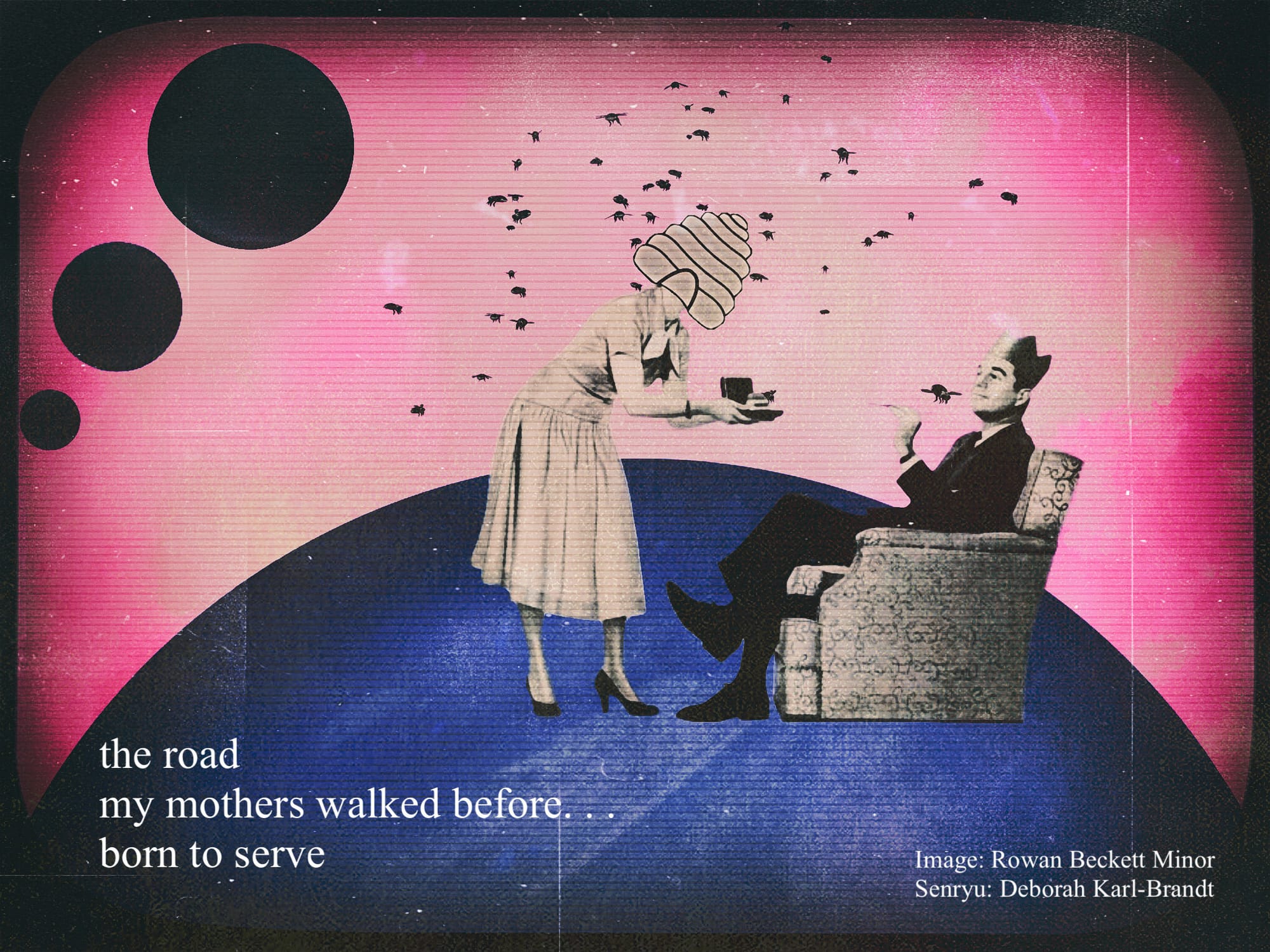
The artwork and poem within "the road" evoke a united feminist message. Deborah Karl-Brandt's poem highlights the familial patterns that pass down from one generation to another with her use of the plural "mothers." The pairing of "the road" with that lingering ellipsis allows the reader to wander down their own family's past. Meanwhile, Rowan Beckett Minor utilizes three expanding dots to mirror the ellipsis and to spatially grow almost as if that 'road' engulfs the following generations. With Karl-Brandt's last line 'born to serve,' it clarifies that those repeated familial patterns are gender roles and are solidified at birth within the nuclear family. Thus, the prominence of the pink and blue color palette emphasizes that context. Then, you add a man stereotypically sitting in a chair with a crown and a woman serving food to the man with her face obscured by a beehive. A faceless woman surrounded by a swarm of bees makes those roles determined at birth feel suffocating. With the attire appearing dated, it tells us that these gender roles from the past are still present now.
To Whom It May Concern
by Pravat Kumar Padhy (prose) and Colleen M. Farrelly (verse)
with commentary from Allyson Whipple
ChatGPT prepares the final agenda. Ms. Mech’Cal, an AI-driven robot, will present on a virtual platform at 2000 Greenwich Mean Time on February 29th. Request to attend the Zoom meeting and present your suggestions, along with a PowerPoint presentation.
It is a system-generated email. Please do not reply.
Digitally signed
(Machine behind the Man)
To my surprise, everything is machine-driven, voiced, presented, and translated! My daughter whispers, “Papa, you may depute your AI representative to speak on your behalf.”
Leaning over my chair, I felt amazed as if I were cloned in this robotic world.

Note from the authors: Sudo-ku-bun is a haikai hybrid similar to haibun that utilizes Kat Lehmann's sudo-ku in place of a single haiku. The grid can utilize any number of squares, typically from 2-5. Sudo-ku-bun is a hybrid form combining prose with sudo-ku (haiku matrix). For more information, check out this essay by Kat Lehmann (Rattle) and this essay by Colleen (MacQueen's Quinterly).
What strikes me most about this sudo-ku-bun are the intentional errors in the prose. The incorrect spacing and awkward phrasing in the third and fifth lines mimic the mistakes that appear in AI-generated text. The choice to end on a sudo-ku reflects the broader cultural ambivalence regarding AI. While there are many who are fully pro-AI and many who are fully opposed, still more are somewhere in between, or unsure what to think at all. Pravat Kumar Padhy and Colleen M. Farrelly have done an excellent job of creating a poem that encapsulates the zeitgeist surrounding AI without being didactic.
trilobites
by Rowan Beckett Minor (image), Deborah Karl-Brandt and Margaret Walker (tan renga)
with commentary from Vidya Premkumar
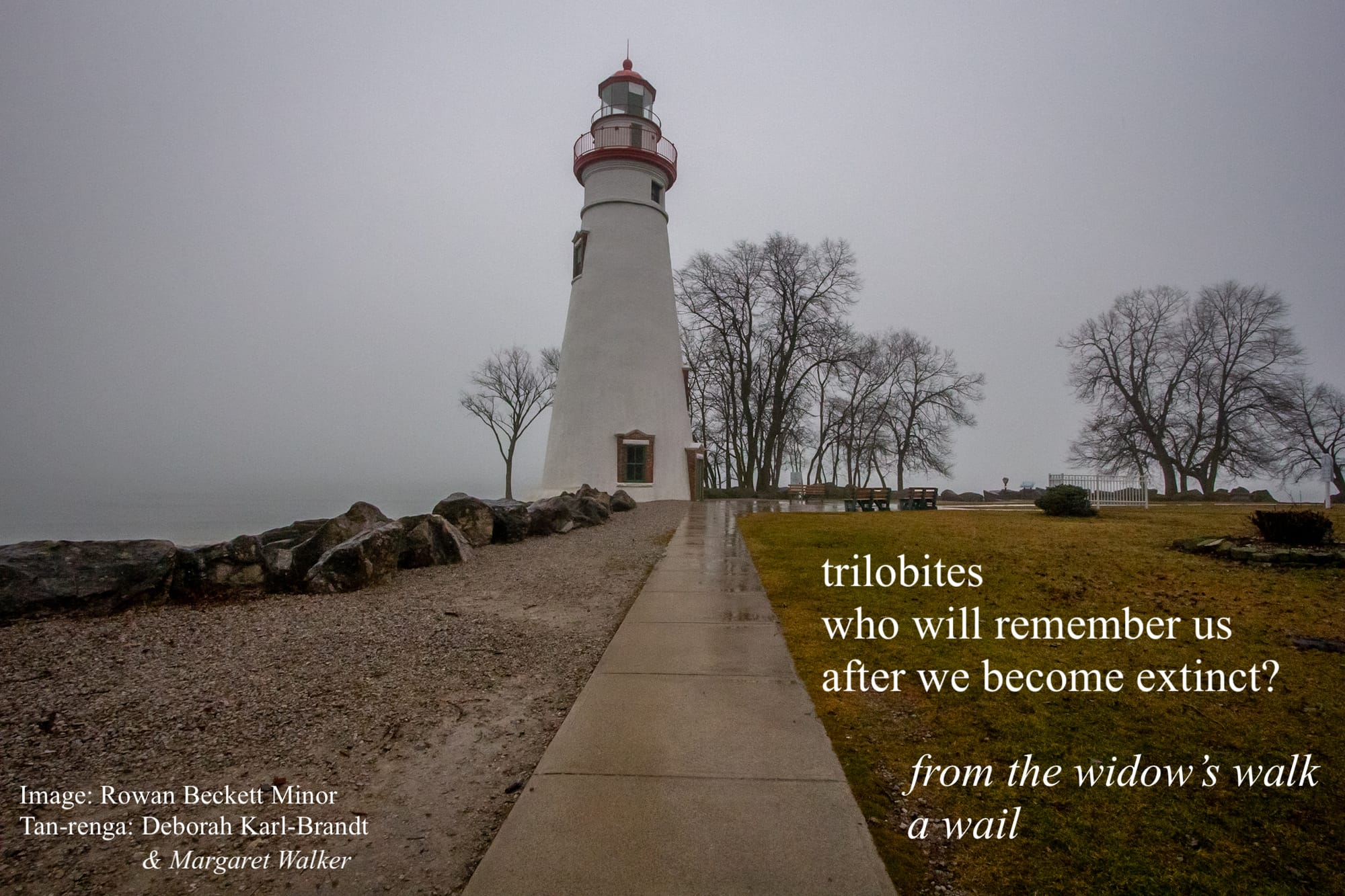
The haiga “trilobites” yokes deep time to intimate grief. It pairs a moody, fog-shrouded lighthouse with a tan-renga that turns geological time into human existentialist crisis. The opening verse invokes trilobites, the long-extinct arthropods, to ask who will remember us, a question that gains weight against the image’s grey Lake Erie shoreline, where the Marblehead lighthouse has stood watch for nearly two centuries. The path leading toward the tower suggests our forward march, yet it also resembles a narrowing corridor into oblivion. Extinction is the slow erasure of a coastal life.
The capping verse, “from the widow’s walk / a wail,” collapses deep time into one sharp human sound. The architectural detail anchors the cosmic question in a specific loss, transforming the lighthouse keeper’s perch into a site of mourning and witness.
spring thaw
by Yvette Nicole Kolodji and Nicky Gutierrez
with commentary from David Green
spring thaw
we talk
religion
if only we saw
the daffodils bloom
This tan renga challenges the old adage, “Never talk about politics or religion.” The poem centers such a discussion topically as well as literally on the page. The “we” of the poem breaks from traditional etiquette deliberately, this talk is necessary. There is much weight in this tiny verse.
“Spring” and “thaw” immediately suggest renewal, rebirth, awakening and growth. More importantly, though, is the melting away of a particular silence. A conversation avoided finally held. Followed, one hopes, by a coming to terms or the end of an estrangement.
In this light, the ending verse seems wistful, regretful. Before this new spring, before the thaw, think of what this relational tension eclipsed, of what was missed, of experiences and time lost.
The daffodils, though, will bloom again . . . .
We hope this collaborative issue has sparked interest and inspiration! Hit comment below to share your thoughts and reactions.
Also, thank you to all who were able to join us for our virtual poetry reading! This event was a wonderful way to close out our second year of Poet Fellows. Last, if you are on our mailing list, keep an eye out for the announcement of winners to the inaugural confluence poetry prize!


Member discussion