
26. Martina Matijević ~ life through different lenses
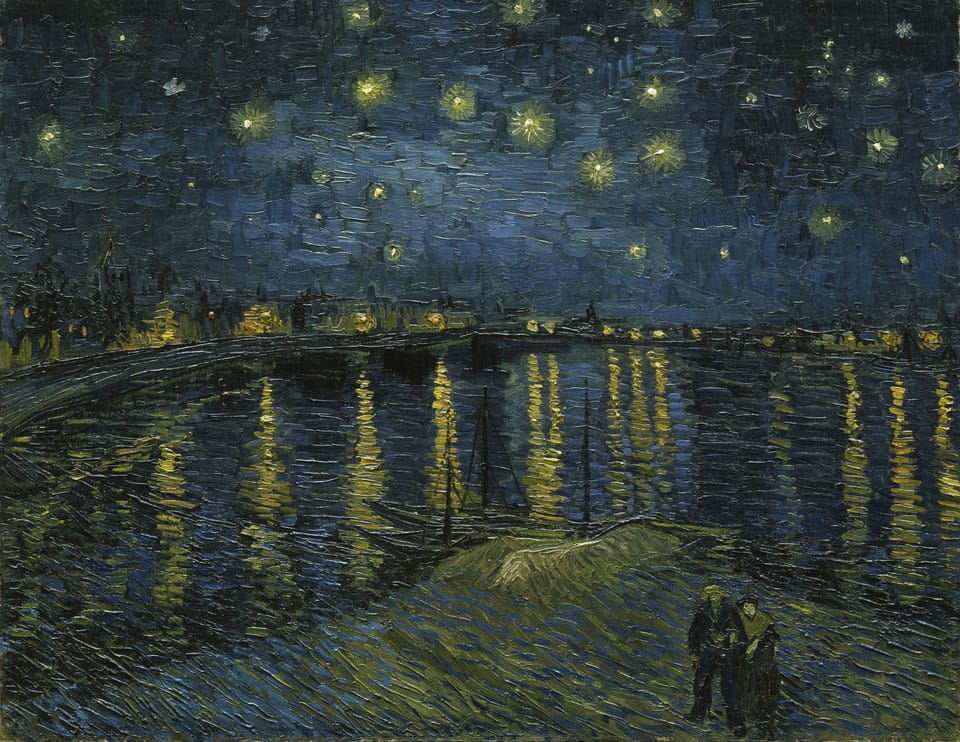
night swim
with each stroke
a new Van Gogh
Martina Matijević’s poems draw on the sky, the stars and galaxies. With a few deceptively simple words she reminds us that whether we are in the author’s own Croatia or any other country on Earth, we see the same skies.
These poems beg to be read aloud. Throughout, the repeated consonance of the “s” moves us through them, giving each word and line a connection to draw us further into the poem.
artificial satellites
circling around me
the how-are-yous
Are the “satellites” concerned friends? The word “artificial” suggests otherwise. We’ve all been there. Acquaintances ask how we are doing. We say “fine”. Socially acceptable but here with a different note—the strong sense of loneliness seen throughout her work. Martina offers us a new lens to examine this social convention.
dark matter
the "I love you"
I left unsaid
Again, she addresses an all-too-common experience. What makes it her own is the first line, "dark matter".
Martina's poems allow us to enter her world and our own. With brevity and seeming simplicity, she repeatedly creates the ma that is a hallmark of fine haiku.
In her poems that paint a life, Martina looks to the heavens for meaning, direction and perhaps, solace. It is this connection of human experience and astronomy that cements the universality of Martina Matijević’s simply sophisticated poetry.
Margaret Walker, confluence associate editor
poems
psych test
my answer sheet
a Suprematist self-portrait
seaside walk
stars take turns
by my side
artificial satellites
circling around me
the how-are-yous
ninth planet
the friends count me
out
ceiling stickers
I arrange them into
a new sky
first math lesson
grandpa shows me how to
count stars
winter time
I sleep in
constellations
dark matter
the "I love you"
I left unsaid
at sunset
grandpa rides his horse —
dleif
ao
Rothk
wheat harvest
father creates
a chaffg
a
l
ay
x
bedroom window
my figure plays hide-and-seek
with constellations
night swim
with each stroke
a new Van Gogh
birch breeze
another phone number
not in use
the last session
the one-fits-all
of her handshake
estate dispute
the family divides
itself
essay
healing connections
Haiku is like dark matter surrounding a moment I want to capture, revealing itself the instant I pull out pen and paper. Just as dark matter unveils the secrets of the cosmos, haiku helps me understand nature on a much deeper level. When speaking of the philosophy of poetry, one is fundamentally speaking of the philosophy of life. Japanese poetry has allowed me not only to view life through different lenses, but also to live a better one.
In an age of constant information overload, minimalism has become a luxury. Sitting down to explore a concept within just a few words feels liberating. I was, and still am, amazed by how these short Japanese poetic forms act almost like invisible matter. They weave together seemingly unrelated phenomena, revealing their connection through juxtaposition.
Curious to test how far this weaving could go, I recently turned toward nonseasonal astronomical haiku. These poems feel like the lingering cosmic radiation of my past, finding its way into the present. This is why I believe haiku is the closest thing poetry has to a time machine—it allows us to relive the past and reach new conclusions in a single breath. While poetry in general can serve this purpose, haiku is unique because the shift happens in a split second. Perhaps that is why, for the first time in my life, I have been able to truly heal from past hardships, leaving my present self deeply inspired.
commentaries from Fellows
Sathya Venkatesh, Meredith Ackroyd & Namkeen Peshawri
Sathya Venkatesh
I enjoyed reading Martina Matijević’s thoughtful essay on haiku, especially the way she connects the form with memory, healing and the way we see life. Her idea of haiku as a kind of “time machine” offers an interesting insight into how a brief moment can open a door to the past and bring new understanding to the present.
I found these poems interesting for the way they bring together the cosmic and the personal. There is a playful, contemporary quality to the writing, with astronomy, art, technology and childhood memories becoming entry points into human emotions. The recurring images of stars, planets, satellites and galaxies create a thread that runs through the collection.
I especially enjoyed
ninth planet
the friends count me
out
The play on "count me out" and the "ninth planet" creates an immediate shift from astronomy to the feeling of being excluded.
artificial satellites
circling around me
the how-are-yous
similarly turns a familiar technological image into something gently poignant—capturing the small greetings that pass between people without necessarily creating closeness.
The tenderness of
first math lesson
grandpa shows me how to
count stars
stayed with me.
I also liked
birch breeze
another phone number
not in use
where the natural image meets the ache of human absence.
The visual experimentation in “grandpa rides his horse” and the “chaff galaxy” poem adds another dimension, making typography part of the experience.
What I appreciate most is the poet’s willingness to make unexpected connections. Some poems are quite cerebral, while others are intimate and nostalgic, but together they explore memory, loss, connection, and impermanence. As a fellow poet still finding my own way with these forms, I found much here to pause over and return to.
Meredith Ackroyd
Martina Matijević approaches the writing of haiku and senryu with freshness and creativity, crafting highly visual poems with deep psychological resonance. While haiku and senryu typically utilize images of the directly observed world and kigo that trigger a shared depth of feeling, many of Martina’s poems use astronomical images and art references to tap into a shared cultural imagery that conjures rich visual images with emotional and psychological resonance.
In her poems that reference art, Martina’s work goes beyond the ekphrastic and instead calls up artistic images as part of a vivid imaginative and emotional landscape: the black-and-white answer sheet of a psychological form test transforms into a geometrical Suprematist self-portrait; a field at sunset vibrates with the brightness and melancholy of a Rothko color field painting; and a night swim calls up the rich textures of Van Gogh’s brushstrokes.
In her astronomical poems, Martina connects her inner psychological world with the far reaches of space. In some poems, Martina expresses a sense of social isolation through space phenomena and technologies, whereas in other poems, she uses the imagery of stars to create a sense of belonging, togetherness, and rightness of place. A sense of the vastness of space serves to highlight the ma of these poems, creating a felt space in which the reader can enter and make meaning in a poetic world that is as wide and deep as the space between stars.
Throughout Martina’s poems, there is a sense that our world—both physical and psychological—is something that we create together: through art, relationships, technologies, our environments, and by being part of a universe that we both embody and reflect. What emerges from the body of her work is a hauntingly beautiful twin portrait of isolation and togetherness, vulnerability and resilience, and darkness and light.
Namkeen Peshawri
What I really like about Martina’s poems is the way she connects the stars, memories, art, and everyday life. While reading them, I felt that many of the poems were about trying to find a place in the world, feeling alone sometimes, and remembering people and moments that stay with us.
I especially liked “first math lesson”, where the grandfather teaches the speaker how to count stars. It is such a simple moment, but it feels very personal and full of warmth. I also liked “ceiling stickers”, where the speaker arranges the stickers into “a new sky”. For me, this shows how we can create our own little world, even when we feel limited by the world around us.
The connection with art also stood out to me. In “psych test”, the answer sheet becomes a self-portrait, and in “night swim”, every swimming stroke becomes a new Van Gogh. I found these images interesting because they show how art can help us express feelings that are sometimes difficult to explain in words.
Some of the shorter poems also stayed with me. “birch breeze”, with its phone number that is no longer in use, made me think about people who are no longer part of our lives. I also found “estate dispute” powerful because it shows how family disagreements can divide people who were once connected.
Martina’s poems are personal, imaginative, and full of interesting details. They encouraged me to pause, think, and find my own meaning in the words.
Thank you for reading! We invite you to continue the conversation by hitting the "comment" button below—let us know your favorite of Martina's poems and your response to her work. Martina and the editors look forward to reading and replying to your comments.
If you liked the issue, we also welcome you to share this with others in your community. Stay tuned for the next monthly issue, which will feature work by Namkeen Peshawri.

Member discussion